Guide
Mature Hairline vs Receding: How to Actually Tell
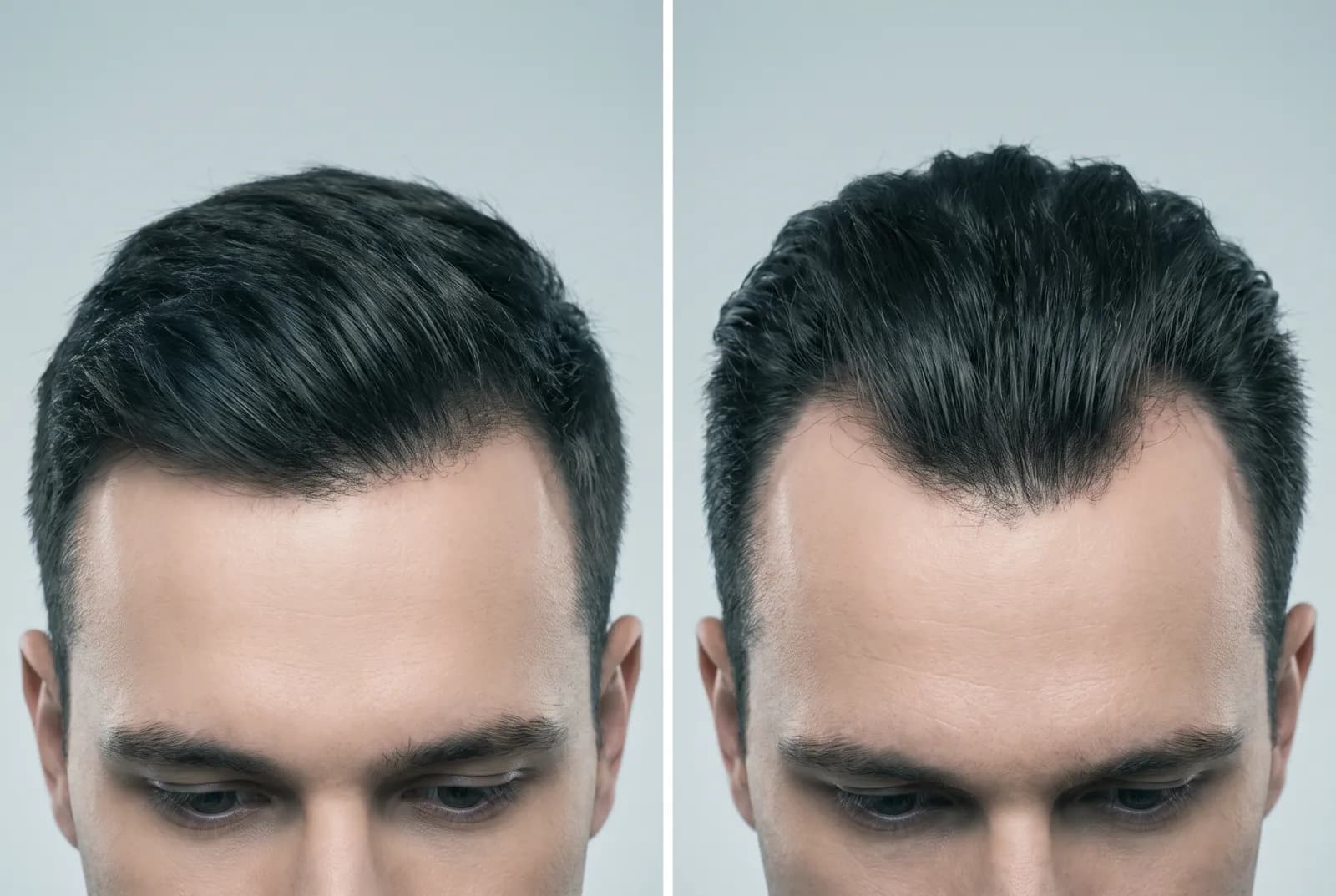
The two can be told apart. Not by a single glance at the mirror — but by shape, pace and company, three checks anyone can run.
The shape check
A maturing hairline moves as a line: the whole front lifts roughly evenly, keeping its shape — perhaps with slight, symmetrical squaring at the corners. On the Norwood scale it drifts from a 1 toward a 2 and parks there. A receding hairline moves as a wedge: the temples retreat distinctly faster than the centre, cutting backwards into an M whose corners keep deepening. Mild widow's peak with shallow corners: maturing. Corners racing the centre: receding.
Depth gives a usable rule of thumb — maturation rarely takes the line back more than about two centimetres from the juvenile position, recession keeps going. Our photo tool measures exactly this geometry (temple depth against centre) if you'd rather have it measured than eyeballed.
The timeline check
Maturation is an event; recession is a process. A hairline that shifted over a year or two in your early twenties and has since held its position is a matured hairline behaving normally. A hairline that is measurably further back in this year's photos than last year's — at 24 or at 40 — is in motion, and motion is the thing that needs a response.
This is why the single most useful diagnostic costs nothing: one front-on photo a year, same light, same distance, hair pushed back. Two such photos beat any amount of daily mirror analysis, which mostly measures lighting and mood.
The company check
Male pattern baldness rarely sends only one signal. A genuinely receding front tends to travel with company: thinning at the crown, a widening parting, more hairs on the pillow than usual, a family album full of the same pattern arriving at the same age. A hairline change with none of that alongside — full crown, stable part, no shedding spike — is overwhelmingly likely to be maturation.
The crown matters most, because it's where pattern loss often shows first and where its owner never looks. Thirty seconds with a phone camera held above and behind settles it, and it's why our tool asks about the crown rather than pretending a front-facing photo tells the whole story.
If it is receding: what the head start is worth
Catching recession early is genuinely valuable — not because panic is warranted, but because holding hair is far easier than regrowing it, and every stage kept is a stage that never needs fixing. Early recession with a moving trajectory is the point where a conversation about treatment pays best; the Norwood 2 and Norwood 3 pages lay out that decision honestly, including when the right move is to do nothing but take next year's photo.
Know your stage first. Every recommendation above keys off how far along you are - the free tool measures it from a photo, on your device, in a minute.
Measure my stageFAQ
Common questions
- How do I know if my hairline is maturing or receding?
- Three checks: shape (even lift with shallow corners = maturing; deepening M = receding), timeline (moved once and stopped = maturing; still moving year on year = receding), and company (a thinning crown or widening part alongside = receding). Any single glance is inconclusive; the three together rarely are.
- At what age does a hairline mature?
- Typically between about 17 and the mid-to-late twenties. A hairline that lifts a little in that window and then holds is following the standard script — it's the continuing movement afterwards, not the initial lift, that distinguishes balding.
- Is a mature hairline the same as Norwood 2?
- They overlap: a matured hairline usually sits at Norwood 2, and Norwood 2 by itself isn't classed as balding. The stage describes a position; maturing versus receding describes whether that position is stable. Position plus trajectory together tell you what's happening.
- Can a mature hairline turn into balding later?
- It can — maturing first doesn't immunise anyone. That's why the annual same-light photo is worth keeping up even after you've concluded it's maturation: it turns any future change into something you catch in a year rather than notice in five.