Guide
Buzz Cut vs Bald: Which Actually Looks Better?
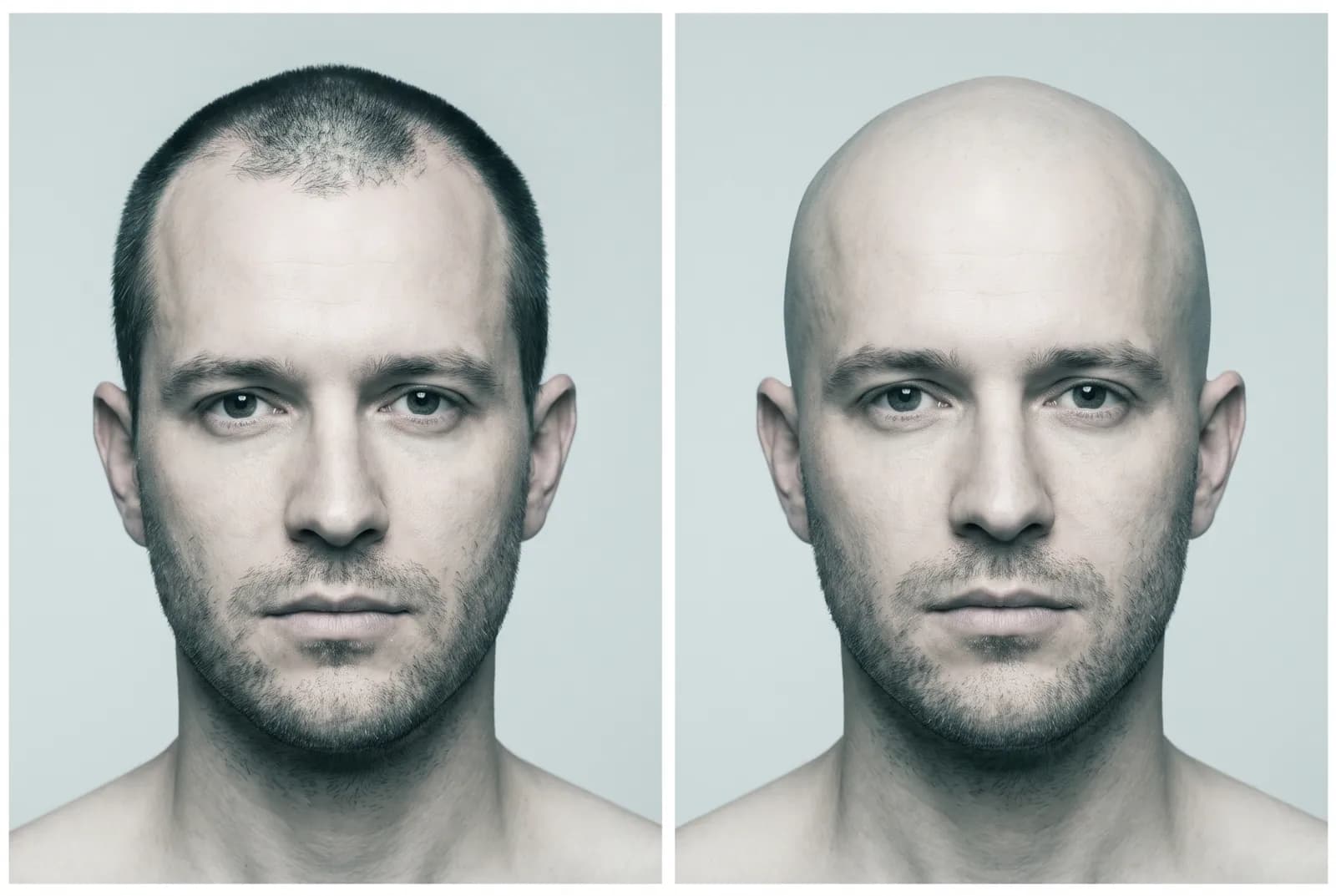
Here's the comparison played straight, on the axes that actually decide it.
Where the buzz wins
The buzz keeps information: hair colour, the shape of coverage, the reassurance of texture. If your loss is thinning or moderate recession, that information still flatters — a buzz shows there's hair while refusing to showcase where there isn't. It's also the gentler transition socially: a buzz is 'a haircut' to your colleagues, while a shave is 'a decision'.
It wins on effort at the start, too: one clipper pass a week, no blades, no technique, no aftercare beyond sunscreen. For anyone at Norwood 2–4, the buzz is usually the better daily deal.
Where the shave wins
The shave deletes the reference point. A buzz over serious loss still displays the pattern — shorter, neater, but legible; scalp and stubble in the bald zones, denser stubble at the sides. The shave replaces 'a man losing his hair' with 'a man with a shaved head', which is a style category with decades of good publicity behind it. From roughly Norwood 5 up, that swap is the single most flattering move available without surgery.
It also wins on line-drawing: no visible horseshoe boundary, no fade to maintain, and — counterintuitively — less anxiety. Men who make the jump consistently report that the daily audit of what's left simply ends. Nothing to monitor, nothing to arrange, rain and wind demoted to weather.
The maintenance fine print
The shave's hidden cost is frequency: a clean-shaved head needs the razor every one to three days to stay clean-shaved, and scalp skin needs a little care a buzzed head doesn't — moisturiser in winter, SPF whenever the sun's out. The buzz's hidden cost runs the other way: it needs the pattern to cooperate, and as loss progresses the guard creeps down until one week the clipper is set to zero and the distinction has quietly dissolved anyway.
How to decide without deciding
The cheap sequence: buzz to a #1. Live with it for two weeks. If it feels like an improvement, you're done — enjoy it. If you catch yourself studying the pattern through the stubble, take the zero-guard pass one weekend and see what a fortnight of that feels like; it's fully reversible in a month of growth either way.
If you want the decision structured rather than vibes-based, the seven-question shave check weighs your stage, trajectory and maintenance temperament and gives you a verdict with its reasoning shown. And if you don't yet know which stage you're arguing about, settle that first — it changes which side of this page applies to you.
Know your stage first. Every recommendation above keys off how far along you are - the free tool measures it from a photo, on your device, in a minute.
Measure my stageFAQ
Common questions
- Is it better to buzz or shave a balding head?
- Buzz while thinning is moderate (roughly Norwood 2–4) — it keeps flattering information and costs less daily effort. Shave once bare zones dominate (roughly 5 and up) — it converts 'balding' into 'shaved head', which reads as intent rather than retreat.
- Does a shaved head look better than thinning hair?
- Almost always, once thinning is past the point where a buzz evens it out. A shaved head is a complete, deliberate style; visibly thinning hair reads as an unresolved one. Between those two poles sits the buzz, which is why the right order of experiments is buzz first, shave second.
- How often do you have to shave your head?
- Every one to three days for a clean-skin look, weekly if you're happy with a shadow. It's a real commitment — the honest counterweight to everything the shave wins on looks.